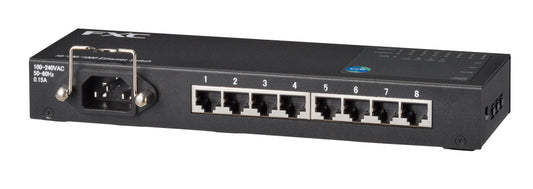
Unlocking Stable Optical Infrastructure: Latest Media Converter Strategies from Japan
Welcome back, tech leaders! Today, we are diving into some fantastic networking insights from a recent online seminar held in Japan this December 2025. Hosted by FXC Corporation, the session—led by FXC Engineer Team—focused on achieving stable optical infrastructure using the latest media converter know-how.
Whether you are expanding a campus network or upgrading bandwidth, here are the key takeaways you can apply to your own infrastructure strategy.
What is a Media Converter and Why Do You Need It?
At its core, a media converter (MC) is a device that bridges different types of transmission media, most commonly converting electrical signals from copper Ethernet cables into optical signals for fiber optic cables. They can also convert optical-to-optical signals, such as transitioning from single-mode to multi-mode fiber.
You might be asking, "Why not just buy an optical switch?". Here is the business case for integrating media converters:
・Distance Extension: Standard LAN cables generally cannot reach beyond 100 meters. Fiber optic lines connected via MCs easily bridge long distances between buildings or remote floors.
・Cost-Efficiency: It is often significantly cheaper to partially upgrade to fiber using MCs to extend distance, rather than replacing your entire existing switch infrastructure.
・Simplicity: If your specific connection does not require advanced L2 or L3 features, an MC offers a simple, plug-and-play extension.
・Noise Immunity: By shifting to optical fiber, your data becomes immune to electromagnetic noise.
・Clear Demarcation: They help establish clear boundaries of responsibility (demarcation points) between different segments or providers within a network.
Hardware Spotlight: LightEdgeXchange Series
FXC highlighted two flagship hardware series designed to scale from the edge to the data center:
1. The LEX1000 Series (The Edge Workhorse)
・This series boasts the world's smallest class of compact design.
・It is built to be simple and robust.
2. The LEX3000 Series (The Enterprise Core)
・Built for large-scale networks, this series prioritizes high density and space-saving.
・It is highly reliable, featuring hot-swappable components and redundant power and fan options.
・It is incredibly scalable, supporting advanced 100G modules, optical amplifiers, and optical filters.
Ensuring High Availability: LFP and OAM Features
Network uptime is critical. To maintain stability, FXC outlined a few vital management features built into their converters:
・LFP (Link Fault Pass-Through): Available on both the LEX1000 and LEX3000 series, this prevents a "one-sided link" scenario. If a copper UTP cable gets cut, the MC automatically drops the optical link as well. This ensures the network correctly registers the link-down state, triggering failover protocols like STP, RSTP, or VRRP to switch to redundant paths.
・Ethernet OAM (Operations, Administration, and Management): Featured on the LEX3000 series, this combines Link OAM and CFM OAM for constant L2 monitoring. This drastically reduces troubleshooting time and operational costs across wide-area networks and includes a "Dying Gasp" feature to alert admins if a remote device loses power.
Scaling Up: High-Density Chassis and WDM Solutions
If you are managing a central hub with multiple media converters, deploying a chassis system is a game-changer. Chassis like the 20-slot LEX3020 or 12-slot LEX1012 reduce power cable clutter, save rack space, and allow for centralized management and monitoring via SNMP. They also bring enterprise-grade reliability by supporting redundant AC/DC power modules.
Furthermore, the LEX3000 series acts as a foundation for broader optical networks. You can easily integrate Optical Amplifiers (to boost signal strength for extra-long distances) and CWDM/DWDM Optical Filters (to multiplex multiple signals onto a single fiber) directly into the chassis.
What's New in the Market?
To wrap up the seminar, FXC announced two exciting product updates:
・New 10G 70km Module: Released in October 2025, the new SFP+SLX70AH and SFP+SLX70BH modules are 1-core LC connector SFP+ modules. They support 10G speeds over a massive 70km distance. Because they use a single fiber for bidirectional communication, they drastically cut down on cabling and installation costs.
・In-Band Monitoring: A new management feature that allows network admins to check statuses and change configurations on remote equipment, as well as the next-hop LEX3000 converter, vastly expanding your remote management scope.